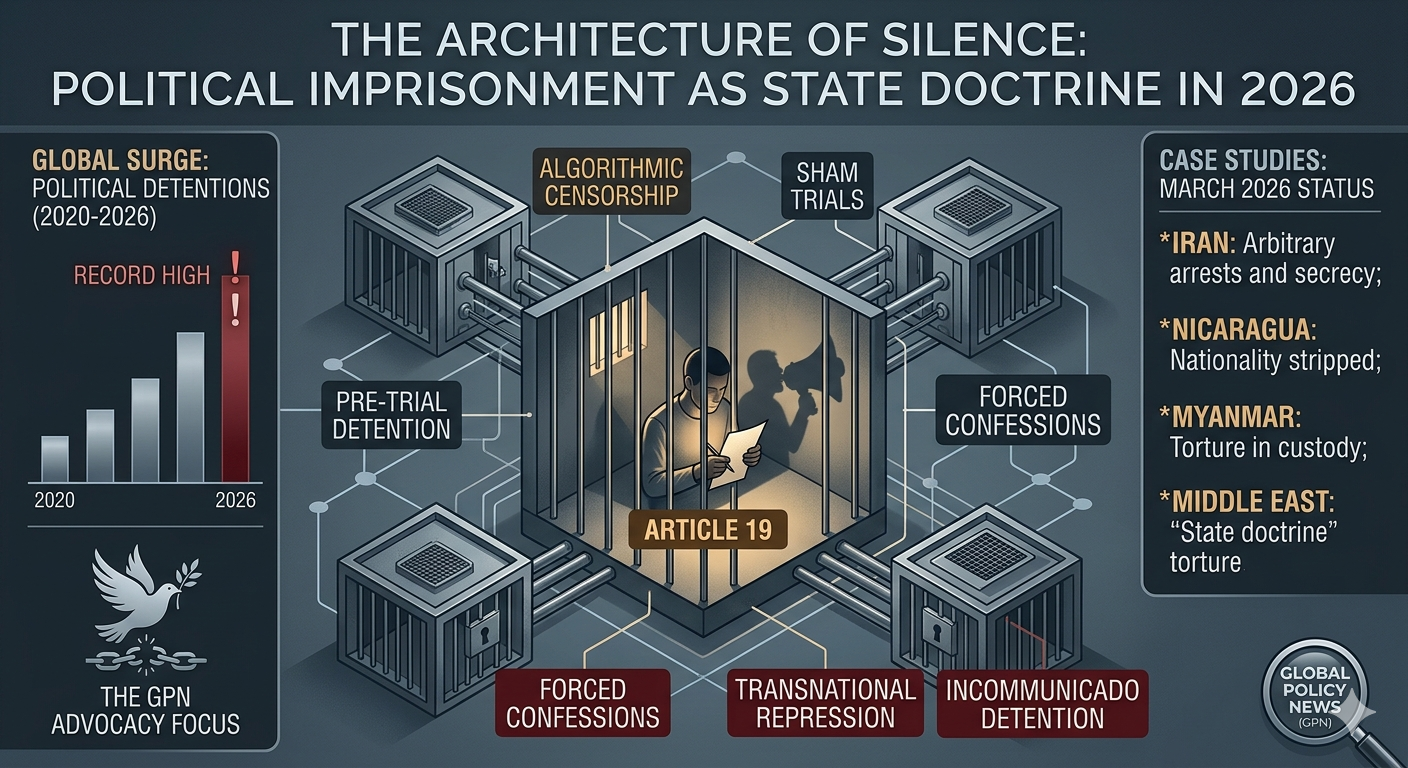
The Architecture of Silence: Political Imprisonment as State Doctrine in 2026


Political Imprisonment as State Doctrine in 2026


By GPN Editorial Staff

As of early 2026, the global landscape of human rights is facing a profound crisis. Political imprisonment—once seen as a vestige of 20th-century autocracies—has been rebranded and intensified through "state doctrine" and digital legal frameworks. For organizations like GPN, monitoring these developments is not merely an academic exercise but a frontline defense of Article 19 and the universal right to freedom of expression.

1. The Weaponization of the Judiciary

Modern regimes have moved away from "extraordinary" measures, instead embedding repression within the standard legal code.

  • The "Cybercrime" Pretext: In 2026, the most common justification for the arrest of journalists and activists is the alleged violation of national security or "anti-misinformation" laws. These broad statutes allow states to categorize any criticism of government policy as a criminal act.

  • Sham Trials and Enforced Disappearances: In regions like Iran and Nicaragua, the "cover of war" or national emergency is being used to justify secret trials. Reports from March 2026 indicate a sweeping wave of over 1,500 arbitrary arrests in Iran alone, where detainees face "manufactured charges" designed to instill fear across the broader society.

2. Totalitarian vs. Authoritarian Detention Models

While both systems use cells to silence critics, their strategic applications differ in scope:

  • Totalitarian Eradication (e.g., North Korea, Myanmar): Imprisonment is used to physically and ideologically erase the individual. In Myanmar, 2026 data shows that the military junta has increasingly resorted to unprovoked airstrikes and the systematic torture of pro-democracy activists in custody, treating the populace as "enemies of the state."

  • Authoritarian Management (e.g., Egypt, Hungary, Venezuela): Detention is used selectively to decapitate the leadership of opposition movements. In Egypt, high-profile bloggers and human rights lawyers are held in prolonged pretrial detention to neutralize their influence without the international backlash of a mass purge.


3. 2026 Global Case Studies: A Snapshot of Repression

Region

Primary Violation

2026 Impact

Middle East

Systematic Torture

UN experts warn that prisons have become "instruments of state doctrine," where torture is used as an integral component of group suppression.

South America

Transnational Repression

Nicaragua has expanded its reach, using constitutional changes to strip nationality from "traitors" and pursuing critics even in exile.

Southeast Asia

Military Tribunals

In Burma, the junta has intensified the use of military courts to sentence civilians, with record numbers of pro-democracy activists losing their lives in custody this year.


4. Defending Article 19: The Path Forward

The UN Convention Against Torture (UNCAT) and Article 19 of the Universal Declaration of Human Rights provide the legal bedrock for international pushback. However, the rise of a "loose international network" of repressive states is actively working to undermine these norms.

For the international community, the mandate is clear:

  1. End "Incommunicado" Detention: Ensuring that every prisoner has immediate access to legal counsel and family.

  2. Decriminalize Speech: Repealing cybercrime laws that equate dissent with terrorism.

  3. Targeted Accountability: Utilizing global sanctions against individual officials responsible for the "manufacture" of political charges.