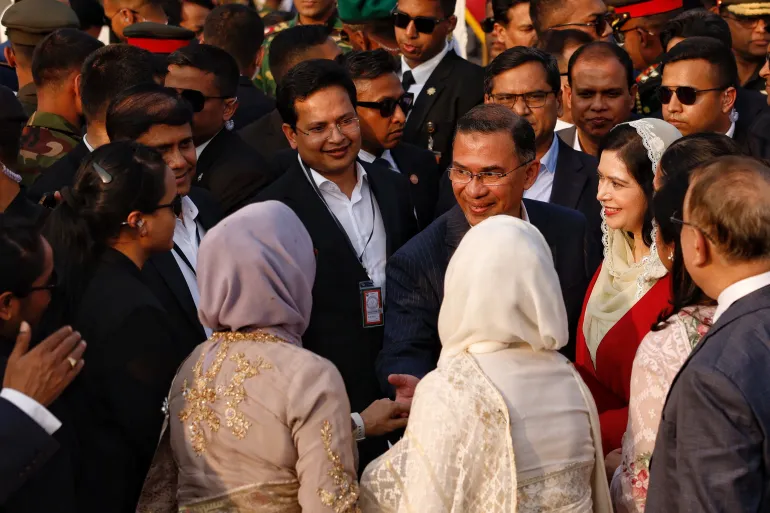
Bangladesh’s newly sworn‑in Prime Minister Tarique Rahman meets guests during an oath‑taking ceremony at the South Plaza of the parliament building Mohammad Ponir Hossain/Reuters

Bangladesh's Reform Promise Hangs in the Balance as BNP and Jamaat Clash Over Charter Oath

A landmark referendum has approved sweeping constitutional change, but a dispute over a single oath is threatening to derail the entire reform process before it begins.


Bangladesh has entered a turbulent new political chapter following a historic double vote on 12 February 2026, in which voters simultaneously elected a new parliament and approved a sweeping package of constitutional reforms. But within days of the results, a bitter dispute over the mechanics of implementation has exposed deep fault lines between the country's newly dominant party and its opposition, raising serious questions about whether the reforms will ever materialize.

A Landslide Victory, A Contested Mandate

The Bangladesh Nationalist Party (BNP), led by Tarique Rahman, won a decisive two-thirds supermajority in the parliamentary election, returning to power for the first time in 17 years following the dramatic ousting of former Prime Minister Sheikh Hasina in the July 2024 uprising. Hasina's Awami League, which had governed for 15 years, was banned from participating in the election altogether.

Alongside the parliamentary vote, a constitutional referendum took place in Bangladesh, with the "Yes" vote passing with 68% of votes in favor on a turnout of 60%. The referendum endorsed the July National Charter 2025 — a landmark document drafted by the interim government of Nobel laureate Professor Muhammad Yunus, based on consensus between 30 political parties, outlining over 80 reform proposals including constitutional, judicial and legislative changes. Key among those proposals are increasing women's political representation, imposing prime ministerial term limits, enhancing presidential powers, expanding fundamental rights, and protecting judicial independence. The charter also proposes creating a 100-member upper chamber to sit alongside Bangladesh's existing 350-seat Jatiya Sangsad — a change that has become the most explosive point of contention.

The Oath That Divided Parliament

The crisis crystallised on the day of the parliamentary swearing-in ceremony. Newly elected members of parliament were asked to take two oaths. The first was the standard pledge to uphold the Constitution of Bangladesh. The second bound them to respect and implement the July National Charter 2025. But the newly elected MPs from the BNP did not take the second oath, prompting criticism from members of Jamaat-e-Islami and its ally, the National Citizen Party (NCP), a party formed by students who led the protests against Hasina in 2024. 

The consequences were immediate and significant. Under an implementation order that sets out how the July National Charter will be turned into law, the Constitutional Reform Council is to be composed of MPs who, at the same ceremony, also take an oath as council members. Because more than two-thirds of the MPs did not take the second oath, the Council has not yet been constituted. It is unclear what will happen next regarding the formation of the council.

The BNP's Defence

The BNP's refusal was not without a legal argument. Salahuddin Ahmed, a BNP standing committee member and MP, told local media that BNP lawmakers had declined the Charter oath because, in their view, the Constitution Reform Council has not yet been approved by parliament. "None of us have been elected as the members of this 'Constitution Reform Council'. This council is not even a part of the constitution yet. It will be considered legitimate only when it is approved by the elected parliament," Ahmed said. 

An oath is not a slogan; it is a constitutional device that signals where authority comes from and what binds office-holders. If a new constitutional body is to be created, the orthodox route is to amend the constitution first, define that body's powers, and then prescribe any oath within the constitution's own schedules and procedures. Forcing a second oath through an executive order, and treating refusal as defiance of "the people," collapses law into politics.

Despite the refusal, the BNP has been careful to reaffirm its commitment to the reforms in principle. Ahmed stated: "We are committed and pledged to implement the July National Charter exactly as it was signed as a document of political consensus." The BNP says that it remains committed to the July Charter, suggesting that it intends to undertake the relevant constitutional reforms through constitutional means, requiring a two-thirds majority parliamentary vote.

The Real Battle: Who Controls the Upper House?

Beneath the constitutional arguments lies a sharper political calculation. The central dispute concerns the proposed upper chamber of parliament and, crucially, how its members would be elected.

Bangladesh currently conducts all elections using the first-past-the-post electoral system. Each voter picks one candidate, and whoever gets the most votes in a seat wins it. This can create a large gap between a party's overall vote share and its actual share of seats. The BNP's landslide 212 seats against Jamaat's alliance of 77 — was built on exactly this dynamic.

The July National Charter proposes filling the upper house through proportional representation, which would allocate seats in line with parties' overall share of the vote. Analysts say this approach could reduce the dominance of large parties in parliament. The BNP, which won 212 seats in the recent election compared with 77 for the Jamaat-led alliance, is believed to favor maintaining an FPTP-based structure. 

As Asif Nazrul, a law professor at Dhaka University, put it: "The BNP favors forming it in proportion to parliamentary seats, while Jamaat and the NCP prefer a system of proportional representation. Resolving this dispute remains a key challenge."

The stakes could not be higher for both sides. Proportional representation in the upper house would give Jamaat and the NCP a level of legislative influence far beyond what their parliamentary seats suggest, potentially giving them a blocking role on constitutional amendments that would otherwise require only a BNP vote.

A Fragile Reform Timeline

Khandakar Tahmid Rejwan, a lecturer in global studies and governance at the Independent University, Bangladesh, told Al Jazeera that the referendum "carries the potential to evolve into a major point of contention in the coming months, particularly between the BNP and the Jamaat-led alliance, which includes the NCP". "The disagreement lies in how, when, and to what extent the reforms will be implemented," he said.

Rejwan also outlined the possible paths forward: "The BNP maintains that the Reform Council lacks constitutional recognition. Therefore, reforms need not depend on that body if parliament itself legislates them. If parliament amends the Constitution to formally establish such a council, it may be created lawfully. If not, reforms can still be enacted through existing legislative procedures."

"Since the referendum produced a 'Yes' mandate, the BNP is politically obligated to implement the agreed reforms. The key questions remain: through which institutional mechanism, on what timeline, and to what extent?"

Adding further legal uncertainty, a writ has been filed challenging the constitutional validity of the referendum and the Presidential Order, suggesting inter alia that both are beyond the framework of the Constitution. The Court has now admitted this petition.

The Broader Stakes

The dispute arrives at a fragile moment for Bangladesh. The country has just emerged from 15 years of Awami League rule marked by repression, electoral manipulation and the killing of hundreds of protesters during the 2024 uprising. The July Charter was conceived as a vehicle for genuine democratic transformation — a break from the authoritarian patterns that defined the Hasina era.

Jamaat and the NCP, whose student base was at the forefront of the uprising, are pushing for rapid implementation on the basis of the referendum result. But with a two-thirds majority, the BNP has the parliamentary power to shape how and how quickly reforms are implemented, and it argues that any structural change must rest on clear constitutional procedure or risk being struck down by the courts.

The tension reflects a classic post-election dynamic: the BNP, now commanding a powerful majority, has considerably less incentive to share power through new institutional arrangements designed when no one knew who would win. Whether it honors the spirit of the mandate that the referendum produced or uses its majority to quietly reshape reforms in its own favor will define Bangladesh's democratic trajectory in the months ahead.

The "Yes" vote does not, by itself, change the Constitution; it is a mandate to change the Constitution. It is considered politically binding, not legally binding. That distinction, it turns out, may determine everything.


Bangladesh's Constitutional Reform Council was due to complete its work within 180 days of its first session. As of late March 2026, the Council has not yet been formed.